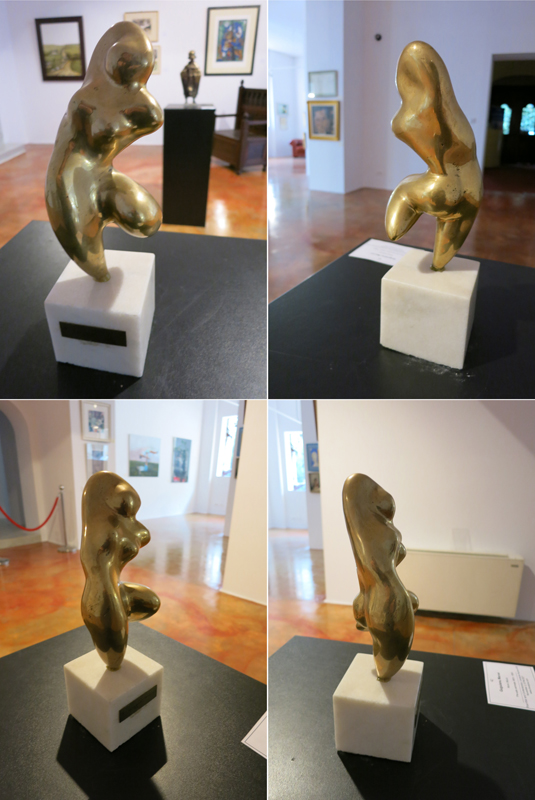
I saw one of Marcel Guguianu’s Muse sculptures at Artmark in Bucharest last fall and was quite taken with it, so much so that I returned to the exhibition hall (the new space they have for showcasing contemporary art) to take a whole slew of photos of her in addition to the few I took the first time. Enjoy.
Marcel Guguianu Muse Bronze 18 x 8 x 6 cm (7.1 x 3.1 x 2.4 in) Pre-sale estimate: €600–€800
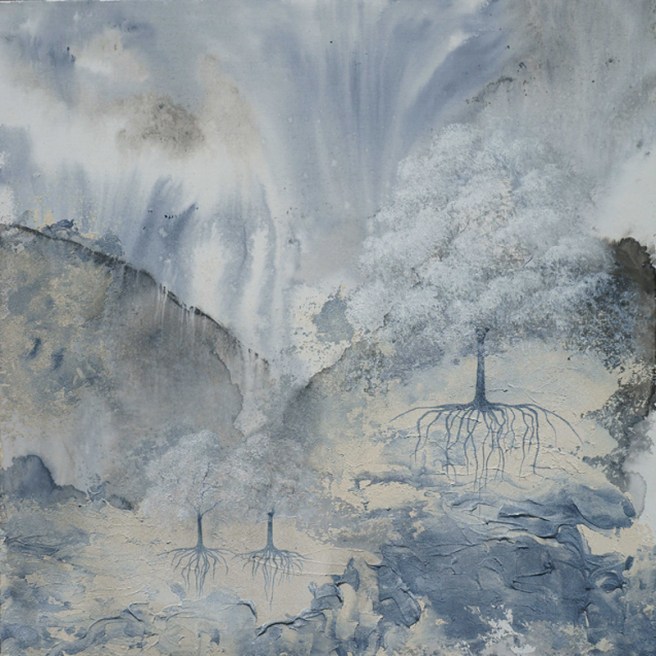
Mira Tudor: Hi Emily, I discovered your paintings in your online gallery at http://www.emilymagone.com and was quite taken with the effects you seem to get with acrylics, as in Misted Trees One, which has a “misty” push and pull redolent of the iridescence of silk. It also has neutral tones reminiscent of Asian art. Which Asian artists, and artists in general, have been important on your journey?
Emily Magone: This is a beautiful question, and something I hadn’t realized until you asked! Being self-taught and growing up in an isolated town, I didn’t have much exposure to the arts (much to my dramatic teenage chagrin). My college degrees are unrelated as well, so my knowledge of art history is rather basic. The most influential artist on my journey remains my high school art teacher, Dave Studebaker—who specialized in Western- and Native American-themed landscapes and scenes—and taught perfect rendering. The world lost him far too early and I have immense gratitude for the safe space and influence his classroom provided during those years.
I have great appreciation for the delicate and peaceful style of Asian art, and I’ve done quite a bit of painting on silk over the past few years as an exploratory medium—which has perhaps influenced my work on other surfaces. But the richness of acrylic on canvas will always have my heart. 🙂
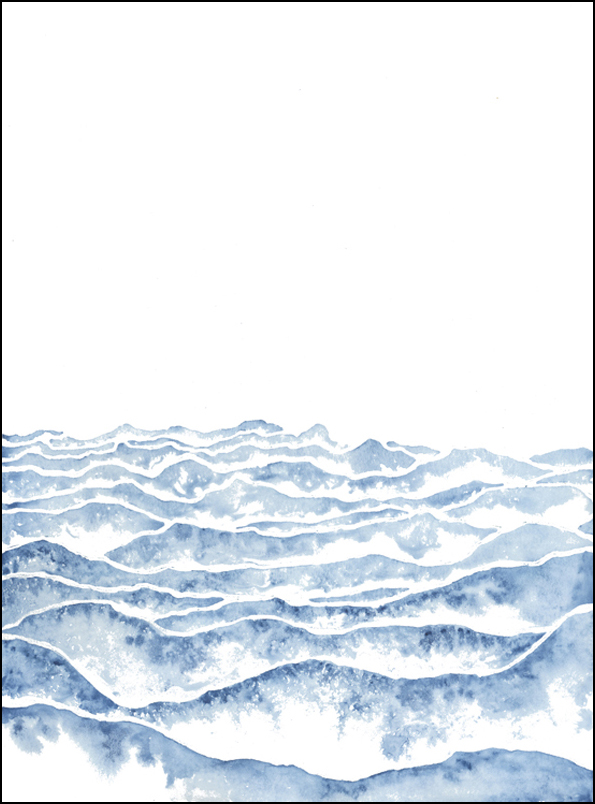
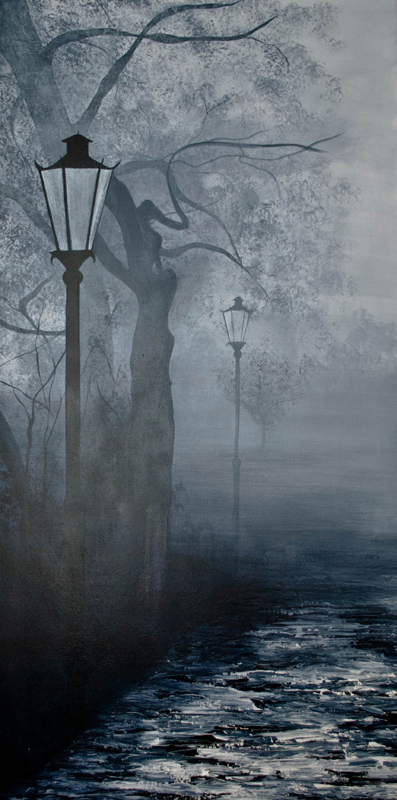
MT: You seem to have spent quite a lot of time with trees, mist, and the sea (or ocean). Why these elements? What do you associate them most with in terms of your inner life? And what are the places that you go back to in your memory when you paint these scenes?
EM: I have indeed! I was born and raised in the northwest corner of Montana with frequent trips to the Washington coast. The trees and mist are elements that bring me the most peace and calm. The floating silence of the fog as it settles between the trees—I can go there in my mind in an instant and feel the cool mist on my face and hear the sounds of the earth minus humans.
These feelings are what I want to bring to others as well: the calm and serenity. It’s so important to maintain our connection with nature on a daily basis. It is healing in so many ways.
My childhood memories of full days spent in the woods on my bike building forts, eating honeysuckle, mushroom hunting, catching giant frogs in the creek, and collecting gorgeous rocks are what fuels my woodland paintings. And I am forever returning to the Pacific Northwest in my mind. The Olympic Peninsula and the Washington coast in particular. Glacier Park, and, in recent years, the Norwegian fjords and the Croatian coast.
One of my next goals is to get some first-hand exposure to the Northern Lights to fuel a full Aurora collection of work!
MT: Thank you, Emily, for this interview. Happy journeys!
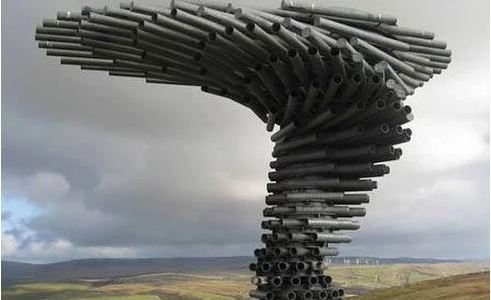
The Singing Ringing Tree is a wind powered sound sculpture resembling a tree set in the landscape of the Pennine hill range in Lancashire, England. The 3-metre tall construction comprising pipes of galvanised steel harnesses the energy of the wind to produce a penetrating choral sound covering a range of several octaves.
Cairn: noun \ˈkern\ A pile of stones that marks a place (such as the place where someone is buried or a battle took place) or that shows the direction of a trail.
via Balancing Act — My OBT (which shows a good number of amazing images documenting these works)
Laura (lunchhourlondon) spends two of her one-hour lunch breaks hunting public contemporary art works in London.
Challenge: Public Contemporary Art
Lunch breaks taken: 2/5
Rating: Enchanting
I have fallen back in love with lunch breaks! Not that I was ever out of love with them, but the past couple of months of busy-ness and subsequently no midday time away from my desk meant that I had gotten used to being a bit lazy. There’s definitely a cosy satisfaction to spending all day at your desk, even though you know it makes you feel drained and heavy by the end of the day. I guess it’s a bit like staying in your pyjamas all weekend: you feel slightly gross, but at the same time self-indulgent.
Because of this, it took me a few weeks to shake off the sluggishness and motivate myself to actually get away from my desk. I undertook the last couple of challenges with a slightly lacklustre approach, not really engaging with them with…
As part of the White Night of the Galleries (September 30), the alternative gallery space at Dr. Iacob Felix no. 72A hosted an installation called Road, about the road of life.
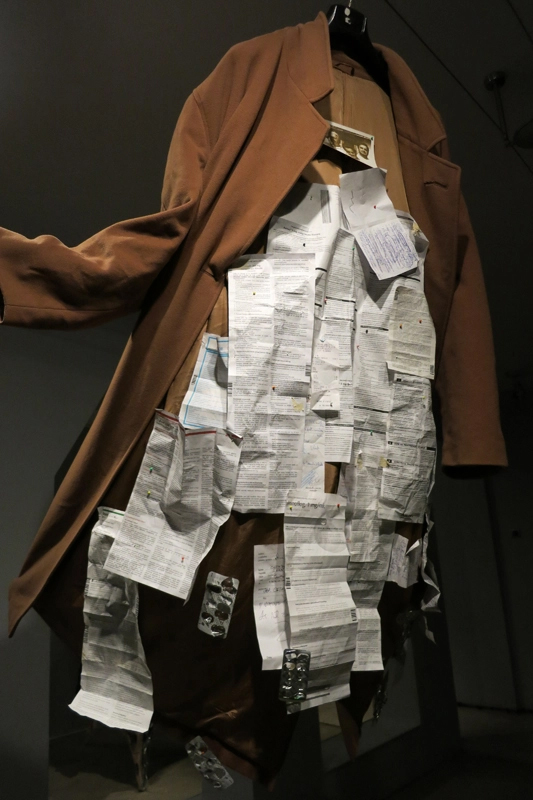
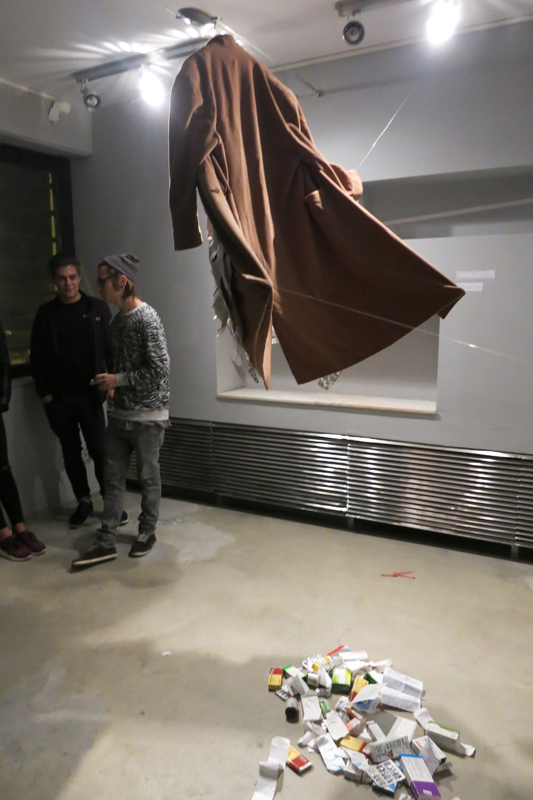
The piece that intrigued me the most, despite its simple concept, showed a family photo and a number of medicine package inserts, blisters of pills, and prescriptions pinned to an old light brown overcoat. The garment hung from the ceiling and a side wall, and underneath it was a pile of medicine packets, pill bottles, and blister packs. The label read Bătrânețea (Old Age), by Rene Răileanu.
Underneath the coat, medicine package inserts and related paraphernalia
The stuff that pushes us up when we fall/fail
Flying high
The piece, with the medicine signifiers replacing the body of the person, made me think how in our old age we’re shaped by suffering and how the fact that we’re still standing under that coat is due to the many medicines we take, medicines which help numb that suffering but which, in many ways, take over our identity as we become more and more concerned with our health, talk often about our ailments, and are perceived through the lens of our illnesses by others. And then there’s the family portrait at the top—what most of us hold most dear in our waning years.
Rene Răileanu is mostly a figurative painter. If you want to see some more of his work, here’s his website.
Walking about Amzei Square yesterday evening, I stopped at Amzei Market Makers to see their current exhibition (curated by Beti Vervega and Mădălina Mirea). One of the artists included in the show was Vlad Basarab (b. 1977, Bucharest), a graduate of the Ceramics section of the University of Alaska Anchorage, as well as of two MFA programs in the US, currently a PhD student in visual arts at the National University of the Arts in Bucharest.
Vlad Basarab is mostly known for the clay books in his Archaeology of Memory series. You can see a photo on ArtOut, accompanying Mădălina Panduru’s interview with the artist, and a video on YouTube, showing in 4 minutes and 31 seconds the way one of these books dissolves under the week-long attritive action of water. In the interview, Vlad Basarab explains that he has left the pages blank in order to allude to oblivion and absence, and to stimulate the viewer to imagine what might have been in those books. Along the same lines, the disintegration of the book suggests the loss of collective memory. For more info in English on Vlad Basarab, see this page from the online art portal Modernism.
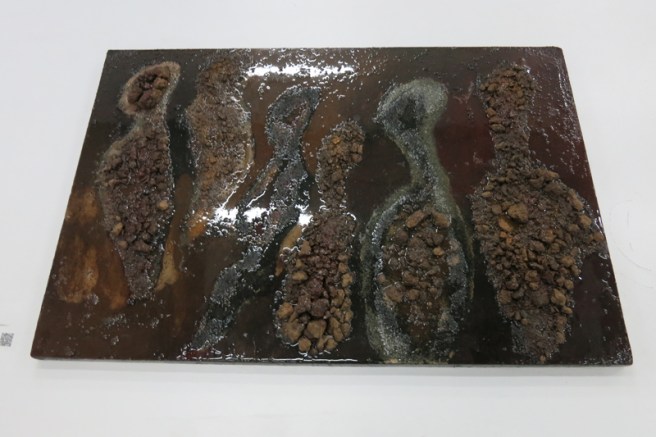
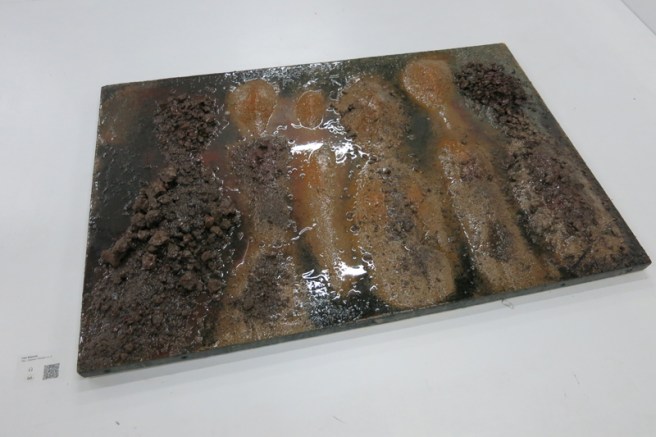
I didn’t get to see his books yesterday, but the works he did contribute to the show were rather strong, too. They were called Oameni Pământ nr. 1 (Earth People No. 1) and Oameni Pământ nr. 2 (Earth People No. 2), and they played with his favorite media, the elementary materials of earth, water, and fire. I thought they were quite inspired. Here they are.
I found this sculpture in the Old Town last night, as part of Bucharest’s tenth edition of the White Night of the Art Galleries, which included a ten-year retrospective at ARCUB. Titled simply Madonna, it’s a work from 2014 by Michele Bressan (b. 1980, Trieste, Italy), who has been residing in Bucharest since 1993.
I’m showing it because this Virgin Mary covered in wax drips made me think of her as carrying our prayers as a light burden . . .
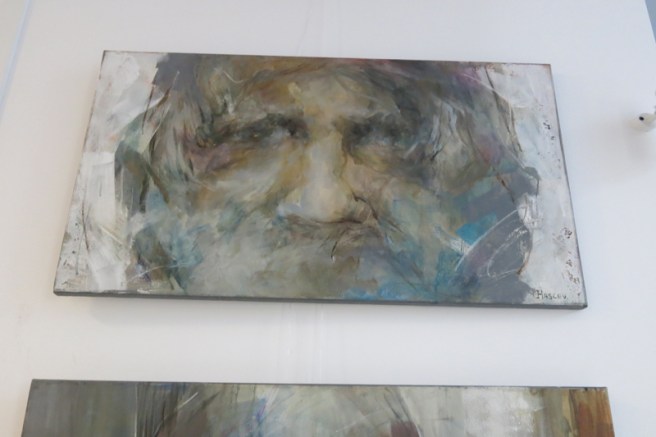
I saw two portraits by Daniela Donțu at Elite Art Gallery a few days ago, and was quite struck by her technique and aesthetic. Here’s Stări (1) / States [of Mind] (1) and Gânduri/ Thoughts.
Daniela Donțu, Stări (1) / States [of Mind] (1)
Daniela Donțu, Gânduri / Thoughts
For some reason I couldn’t identify right away, I found these paintings mesmerizing. It took some photographing of old photos to realize what has drawn me to Donțu’s work, States [of Mind] (1) in particular. It’s the way the fluid handling of paint creates the suggestion of reflection-filled layers, as if you were looking at the man through a series of windows—or veils of affective memory.
Cătălin Burcea, The First and Last Step, at Victoria Art Center in Bucharest
I visited the new exhibition at Victoria Art Center yesterday, and, while I liked all the pieces, I was quite impressed with one of them in particular, Cătălin Burcea’s The First and The Last Step (Primul și ultimul pas, in Romanian).
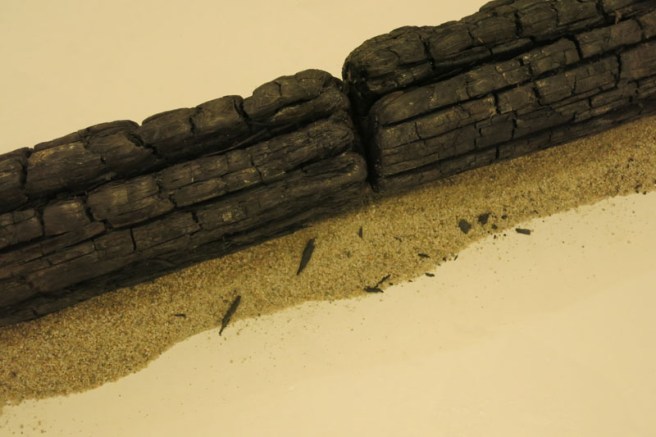
The work consists of four segments of charred wood laid upon a narrow bed of sand. First things first: why four pieces and a single log? The parts may be a reference, perhaps, to the four nucleotide bases of a DNA strand, or, alternatively, to the idea of steps—considered separately from the first and the last step mentioned in the title. Moving on, it’s easy to see why these pieces of wood, passed through fire, a step before returning to the earth as ashes, is the last step (and you can see in the detail below how chips of it are already coming loose and taking that road). But how is it the first step? Maybe the fire that consumes us is a spiritual moment that allows us to be born. Maybe we’re already charred wood when we’re born (the old idea of birth as the first step towards death). I feel it’s this second idea, tied to birth, that gives this piece its oomph. The idea that with every breath we take we die a little—just as a light breeze will eat at this charred log.
Here’s a detail.
Cătălin Burcea, The First and the Last Step (detail)






![Daniela Dontu, States [of Mind] (1), at Elite Art Center](https://miratudor.com/wp-content/uploads/2016/09/img_5407_daniela-dontu_states-of-mind_1_elite-art-gallery1.jpg?w=656)

 The Art Dive